Project-Type Priorities 建筑类型优先级
Each project may also have project-type priorities that have additional importance to the project because of its building type. How a building will be used heavily influences its priorities and applicable strategies. For example, a building's use impacts aspects like the amount and type of waste it generates (e.g., a restaurant generates more food waste than a data center) and the populations that will be present in the building (e.g., children will spend significant amounts of time in a school building).
每个项目也可能因建筑类型而拥有建筑类型优先级,建筑用途会显著影响其目标与策略选择。例如,建筑用途会影响产生的废弃物数量与类型(如餐厅比数据中心产生更多厨余垃圾),以及建筑内的人群构成(如儿童会在学校建筑中长时间活动)。
Green Building Strategies 绿色建筑策略
Green building project teams implement strategies based on the type of building they are designing, constructing, and operating. Examples of specific space types include:
- Office buildings
- Schools
- Retail stores
- Healthcare settings
- Data centers
- Hotels
- Warehouses and distribution centers
- Homes (including single-family and multifamily buildings)
绿色建筑项目团队会根据建筑类型制定相应策略,常见建筑类型包括:
- 办公楼
- 学校
- 零售商店
- 医疗场所
- 数据中心
- 酒店
- 仓库与配送中心
- 住宅(包括独栋与多户住宅)
Each of these spaces has unique circumstances that impact how the project team will approach sustainability.
这些建筑类型各自的特点,都会影响项目团队实现可持续性目标的方式。
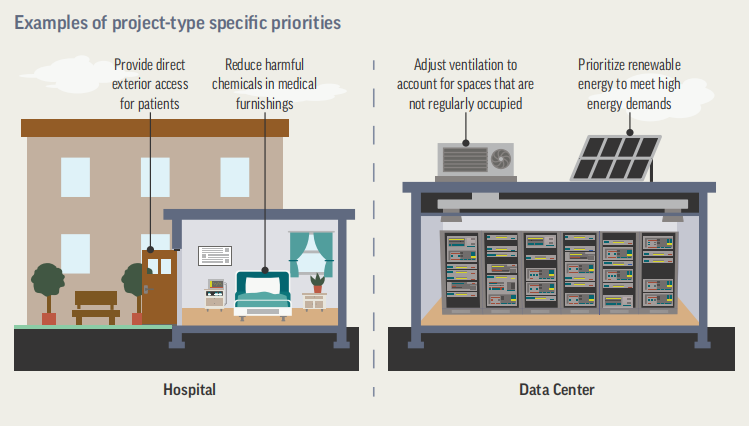
Examples of project-type specific priorities 建筑类型优先级示例
- Hospital 医院:
- Provide direct exterior access for patients(为患者提供直接的室外通道)
- Reduce harmful chemicals in medical furnishings(减少医疗家具中的有害化学物质)
- Data Center 数据中心:
- Adjust ventilation to account for spaces that are not regularly occupied(针对非人员长期停留的空间调整通风策略)
- Prioritize renewable energy to meet high energy demands(优先采用可再生能源,满足高能耗需求)


 京公网安备 11010602007285号