HVAC Systems
暖通空调系统
Heating, Ventilation and Air-Conditioning (HVAC) systems regulate a building's temperature, humidity, and indoor air quality. An important component of this is ventilation, the exchange of air between the indoors and outdoors.
采暖、通风与空调(HVAC)系统用于调节建筑的温度、湿度及室内空气质量,其中核心环节为**通风**,即室内外空气的交换。
In some buildings, ventilation can be achieved passively with architectural features like breezeways and operable windows. However, passive ventilation has several limitations: the airflow might not be reliable and might not reach the entire building, and outdoor conditions may cause the air to be uncomfortable or unsafe.
部分建筑可通过通风廊道、可开启窗等建筑构造实现**被动通风(自然通风)**。但自然通风存在局限:气流不稳定、无法覆盖建筑全域,且室外气候可能导致送风舒适度差或存在安全隐患。
Therefore, most buildings require mechanical ventilation to condition incoming air. Mechanical ventilation uses a significant amount of energy.
因此多数建筑采用**机械通风**处理新风,而机械通风会消耗大量能源。
Green Building Strategies
绿色建筑策略
Green building strategies aim to reduce the energy required to condition the air by:
绿色建筑通过以下方式降低空气处理能耗:
- Sizing the HVAC system appropriately based on the estimated building loads.
- 依据建筑预估负荷,合理匹配暖通空调系统容量。
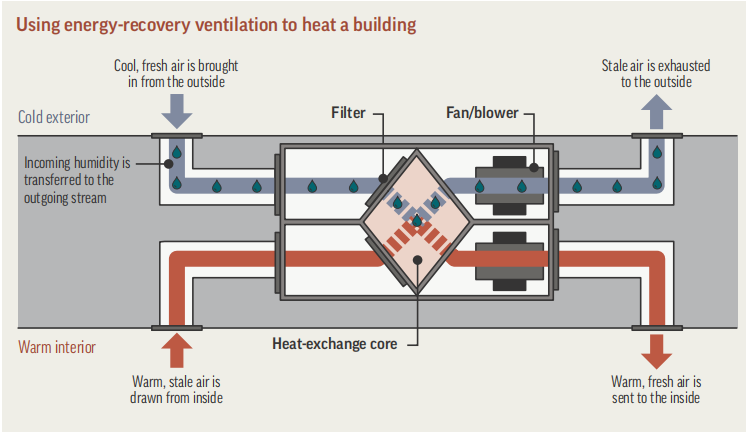
- Using energy?recovery ventilation, which uses the outgoing air to help condition the incoming air. An energy-recovery ventilation system has two separate airstreams: one that supplies fresh outdoor air to the inside and one that exhausts stale indoor air to the outside.
- 采用**能量回收通风系统(ERV)**,利用排风预处理新风;系统包含两条独立气流:一条向室内输送室外新风,另一条将室内污浊空气排出室外。
Using energy-recovery ventilation to heat a building
利用能量回收通风为建筑供暖


 京公网安备 11010602007285号