Water Efficiency
用水效率
Buildings use water for many functions, including in operations, outdoor spaces, and indoor fixtures.
建筑用水用途广泛,涵盖日常运营、户外场地及室内用水器具。
The amount and type of water used for each of these functions determines the total impact that a project has on water resources.
各项用途的用水量与用水类型,决定了项目对水资源产生的总体影响。
Why it matters:
重要意义:
Clean drinking water is a limited resource that requires a significant societal investment.
Nearly 97% of Earth’s water is seawater, which is not suitable for drinking unless it is treated through a very energy?intensive process.
地球近 97% 的水资源为海水,除非经过高能耗处理,否则无法饮用。
Almost all of the remaining water is either frozen (in glaciers and ice caps) or locked up in groundwater.
剩余水资源几乎全部以冰川、冰盖形式冻结,或封存于地下水中。
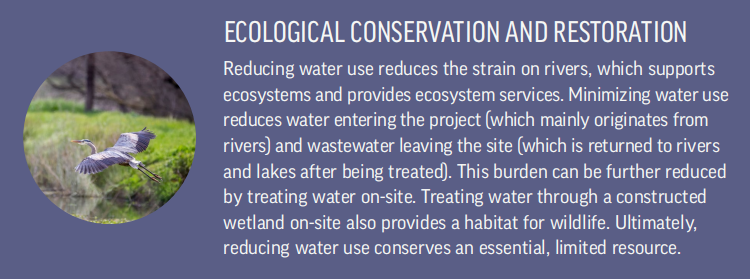
Most drinking water comes from rivers, which make up just 0.05% of Earth’s freshwater.
大部分饮用水来自河流,而河流仅占地球淡水资源的 0.05%。
Rivers also support many ecosystems and ecosystem services.
河流同时维系着众多生态系统,提供各类生态服务。
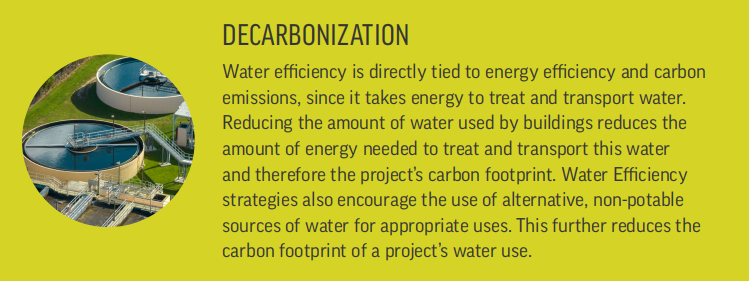
The treatment and transportation of water require large amounts of energy and represent the largest use of energy for most municipalities in the U.S., typically accounting for 30–40% of energy consumption.
- 水资源处理与输送需要消耗大量能源,在美国多数城市中,这是最大的能源消耗项,通常占总能耗的 30%?40%。
If the energy used to treat and transport water is produced by fossil fuels, conveying water between treatment plants and projects can have a significant carbon footprint.
若水处理及输水能源来自化石燃料,水厂与项目之间的输水过程将产生显著的碳足迹。
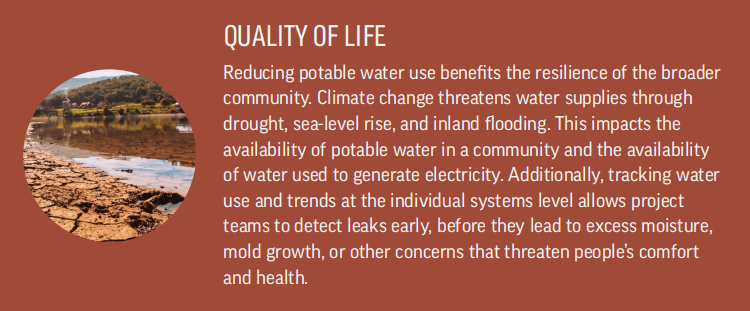
Climate change presents several threats to the water supply, the most direct of which is widespread drought, leading to water shortages.
- 气候变化对供水系统构成多重威胁,最直接的是大范围干旱,进而引发水资源短缺。
Sea-level rise and inland flooding also can harm supplies of freshwater in coastal areas and contaminate rivers and streams.
海平面上升与内陆洪涝,也会破坏沿海淡水资源、污染河溪。
Water is also used in energy production, both in conventional fossil?fuel–burning power plants and in renewable energy sources, like hydroelectric dams.
- 能源生产同样消耗水资源,既包括传统化石燃料发电厂,也包括水坝等可再生能源设施。
This means that limited water resources can disrupt both energy generation and water availability.
这意味着水资源短缺会同时制约能源生产与供水保障。

How Water Efficiency strategies can help:
用水效率策略的作用:
Green buildings implement water?saving strategies in order to use water wisely.
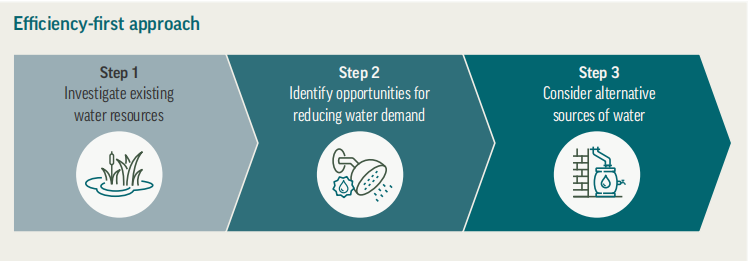
Project teams follow an integrative process that begins with assessing existing water resources based on the project site and location, identifying opportunities for reducing water demand, and, finally, incorporating alternative water supplies that reduce the demand for clean drinking water.
项目团队采用综合设计流程:首先结合项目场地与区位评估现有水资源,挖掘用水需求削减潜力,最后引入替代水源,降低对清洁饮用水的依赖。
This efficiency?first approach allows project teams to maximize their impact.
这种效率优先的方式,能让项目团队实现节水效益最大化。
Integrative project teams consider water conservation goals holistically, as part of overall goal setting.
- 综合项目团队从整体层面统筹节水目标,将其纳入项目整体目标设定。
Water conservation goals impact site planning (e.g., whether to construct a wetland to treat wastewater), project resilience (e.g., whether to select a heating and cooling system that requires minimal water to function), and occupant health (e.g., whether to provide showers for cyclists).
节水目标会影响场地规划(如是否建设湿地处理废水)、项目韧性(如是否选用耗水量极低的暖通系统)、使用者健康(如是否为骑行者提供淋浴设施)。
Tracking water use at a granular level with meters allows projects to identify problems early and make informed decisions about specific water?conservation strategies.
- 通过水表精细化监测用水量,项目可尽早发现问题,为制定针对性节水策略提供科学依据。
Projects can reduce total water use by minimizing water used for irrigation, indoor fixtures, and building processes.
- 项目可通过减少灌溉、室内用水器具及建筑运维过程的耗水量,实现总用水量削减。
WATER EFFICIENCY TERMS
用水效率术语(LEED v5 逐句精准对照)
POTABLE WATER 饮用水
Potable water: Clean water that is suitable for drinking.
饮用水:适合饮用的洁净水。
NON-POTABLE WATER 非饮用水
Graywater: Wastewater from sinks, tubs, showers, and clothes washers that have not come in contact with toilet waste.
灰水:来自洗手池、浴缸、淋浴、洗衣机,且未接触马桶污物的废水。
Non-potable water: Water that does not meet drinking water standards, such as wastewater and collected rainwater.
非饮用水:不符合饮用水标准的水,例如废水、收集的雨水。
Wastewater: Water that has been used for a purpose and conveyed by building plumbing systems toward a point of treatment and disposal.
废水:经过使用后,由建筑管道系统输送至处理和排放点的水。
WATER METERING 用水计量
Water-end-use profile: A summary that identifies the most significant uses of water in a project in order to evaluate the impact and benefits of specific sustainability strategies.
用水末端用途分析:梳理项目主要用水环节,用于评估特定可持续策略的影响与效益。
Water meters: Equipment that measures the flow of water to a project.
总水表:计量流入项目总水量的设备。
Water submeters: Meters that report the volume of water used by individual systems and fixtures within the project.
分项水表:计量项目内各独立系统、用水器具用水量的仪表。
OUTDOOR WATER USE 室外用水
Xeriscaping: A landscape that consists of drought?tolerant native or adapted plants along with rocks, bark mulch, and other landscape elements that do not require routine irrigation.
旱生景观 / 节水型景观:由耐旱原生或适生植物,搭配岩石、树皮覆盖物等组成,无需常规灌溉的景观形式。
INDOOR WATER USE 室内用水
Flush and flow rates: Published values on the amount of water each fixture uses, provided by the fixture manufacturer. For toilets and urinals, the flush rate indicates the liters or gallons of water used per flush. For faucets and showers, the flow rate indicates liters or gallons used per minute at full flow.
冲水流量与出水流量:用水器具厂商标注的单位耗水量。马桶、小便池为每次冲水量;水龙头、淋浴为满流状态下每分钟出水量。
High?efficiency fixtures: Plumbing fixtures that either conserve water (e.g., low?flow lavatories and dual?flush toilets) or eliminate demand entirely (e.g., waterless urinals and composting toilets).
高效节水器具:可节约用水(如低流量面盆、双冲马桶)或完全不用水(如无水小便池、堆肥马桶)的给排水器具。
PROCESS WATER USE 工艺用水
Cooling tower: A component of a building’s cooling system that uses the evaporation of water to release heat from air?conditioning systems.
冷却塔:建筑制冷系统部件,利用水分蒸发为空调系统散热。
Process water: Water used for building systems, such as cooling towers, boilers, and chillers. This can also refer to water used in commercial and industrial dishwashing, clothes washing, and ice making.
工艺用水:用于冷却塔、锅炉、冷水机组等建筑设备的水;也指商用 / 工业洗碗、洗衣、制冰用水。
LEED Impact Areas: Water Efficiency
The Water Efficiency strategies in LEED address all three of LEED’s impact areas:


 京公网安备 11010602007285号