Adaptable Environments 可适配环境
An occupant's comfort in a space is impacted by their ability to change it. Being in control of elements like lighting, temperature, and comfort in furniture all contribute to people's perception of a space. People tend to be satisfied with a wider range of conditions when they can modify them. Additionally, people of all shapes and sizes need comfortable spaces. Oftentimes, spaces such as kitchens, bathrooms, and waiting areas are designed to comfortably accommodate a standard size that does not work well for all people. Finally, as more and more natural environments are replaced with buildings, people have fewer opportunities to spend time outside. People benefit from spending time outdoors, when conditions permit.
使用者对空间的舒适度感受,很大程度上取决于他们对环境的自主调节能力。对灯光、温度、家具舒适度等元素的掌控感,会直接影响人们对空间的评价。当人们能够自行调整环境时,对不同条件的接受度会更高。此外,不同体型的人群都需要舒适的空间,而厨房、卫生间、等候区等场所往往按 “标准尺寸” 设计,无法适配所有人的需求。同时,随着越来越多的自然空间被建筑取代,人们接触户外的机会减少,而在条件允许时,户外活动对健康有益。
Green Building Strategies 绿色建筑策略
Green buildings allow occupants to make adjustments to their environment. Strategies include providing:
- Operable windows
- Adjustable window coverings
- Thermostats
- Multiple spaces to support different needs
- A range of surface and sink heights
- Stepstools and railings
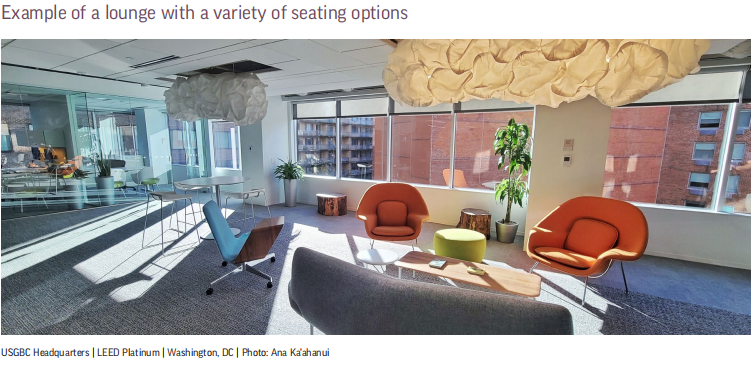
- A variety of seating options, including seats that can be adjusted
- Semi-sheltered access to outdoor spaces
绿色建筑为使用者提供了环境调节的可能性,相关策略包括:
- 可开启的窗户
- 可调节的窗帘 / 遮阳装置
- 温控器(允许调节室内温度)
- 满足不同需求的多样化空间
- 不同高度的台面与水槽
- 踏脚凳与扶手
- 多种座位选择(含可调节座椅)
- 半遮蔽式的户外空间出入口
Implementing these approaches can improve functionality and comfort for people of all ages, shapes, and sizes.
这些措施能显著提升不同年龄、体型人群的使用功能与舒适度。
示例图片
图为美国绿色建筑委员会(USGBC)总部(LEED 铂金级认证)的休息区,通过多种可调节座椅、大面积采光窗等设计,为使用者提供了舒适、灵活的环境。


 京公网安备 11010602007285号