Transportation Demand Management
交通需求管理
Even if a project is in a densely developed, walkable area with lots of amenities, its location can still be difficult for many people to get to. It is important to consider how people travel to and from the project site.
即便项目选址于开发密集、步行友好、配套完善的区域,对部分人群而言仍可能出行不便。因此需要重点考量人们往返项目场地的出行方式。
The widespread prevalence of single?occupancy vehicles (also known as single?passenger vehicles), regardless of their fuel source, has many costs, including noise pollution, environmental damage from building and repairing roadways, hazardous emissions from tires as they wear, and the space that the infrastructure to support driving requires.
单人乘用车(无论燃料类型)的广泛使用会带来诸多负面影响,包括噪声污染、道路修建与养护造成的环境破坏、轮胎磨损产生的有害排放物,以及机动车配套基础设施占用的大量土地空间。
A key metric for project owners and operators to consider is vehicle miles traveled (VMT), which is the estimated annual sum of miles traveled by people driving to and from the project site.
项目业主与运营方需重点关注一项核心指标:
车辆行驶里程(VMT),即人员驾车往返项目场地的年度预估总行驶里程。
Green Building Strategies
绿色建筑策略
Green buildings leverage sustainable location and transportation strategies to reduce the prevalence of single?occupancy vehicles commuting to and from the project site, thus reducing the project’s VMT.
绿色建筑运用可持续的区位与交通策略,减少单人乘用车通勤往返项目场地的情况,从而降低项目的
车辆行驶里程(VMT)。
Project teams take a holistic approach to reducing VMT through transportation demand management (TDM), which is a set of strategies aimed at maximizing traveler choices to encourage more sustainable transportation decisions. TDM leverages both existing infrastructure and design choices to influence travel behavior by making alternatives to single?occupancy vehicles more efficient and attractive.
项目团队通过 ** 交通需求管理(TDM)** 综合降低车辆行驶里程。交通需求管理是一系列策略,旨在丰富出行选择,引导可持续出行方式。该方式结合现有基础设施与场地设计,提升非单人乘用车出行方式的便捷性与吸引力,以此引导出行行为。
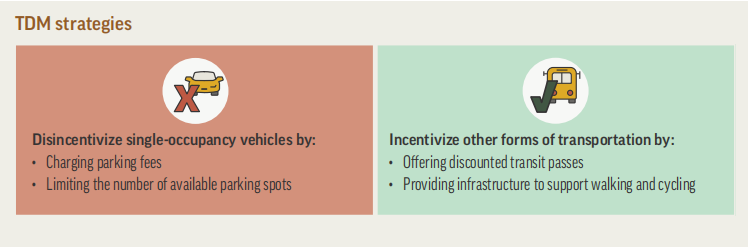
TDM can be used in two main ways to reduce VMT:
交通需求管理主要通过两种方式降低车辆行驶里程:
? Through disincentives that discourage people from driving single?passenger cars — for example, charging parking fees or reducing the parking footprint (the number of available parking spots) of the building.
- 约束性措施:抑制单人驾车出行,例如收取停车费、减少建筑停车位规模(可用停车位数量)。
? Through incentives that encourage other forms of transportation — for example, offering discounted transit passes or providing infrastructure to support walking and cycling
- 激励性措施:鼓励其他出行方式,例如提供交通卡折扣、建设步行与骑行配套设施。


 京公网安备 11010602007285号