Particulate Matter and Air Filtration 颗粒物与空气过滤
As discussed in Chapter 9: Materials and Resources, some ingredients in building materials are known to be hazardous both in the short-term (e.g., VOCs triggering a headache) and in the long-term (e.g., radon exposure increasing lung cancer risks).
如第 9 章《材料与资源》所述,部分建筑材料成分存在短期和长期危害,例如挥发性有机物(VOCs)引发头痛,氡气暴露增加肺癌风险。
While specific chemicals are known to be harmful, the complete picture of IAQ is more complicated because of the complex mixture of many different contaminants in the air. Even if the air does not contain a high level of a specific known health hazard, the mixture of many contaminants together can still pose a risk.
虽然特定化学物质的危害已明确,但由于空气中多种污染物的复杂混合,室内空气质量(IAQ)的评估更为复杂。即使空气中单一污染物浓度不高,多种污染物的混合物仍可能带来健康风险。
Pollutants come in many forms, shapes, and sizes and can circulate indoors as a chemically reactive mixture called particulate matter (PM), which is a mixture of solid particles and liquid droplets found in both indoor and outdoor air. Some particles, such as dust, dirt, soot, or smoke, are large enough or dark enough to be seen with the naked eye. Others are so small that they can only be detected using an electron microscope.
污染物形态、大小各异,会以一种被称为 ** 颗粒物(PM)** 的化学反应混合物形式在室内循环,即室内外空气中固体颗粒与液滴的混合物。灰尘、污垢、烟尘等颗粒肉眼可见,而其他微小颗粒则需电子显微镜才能检测。
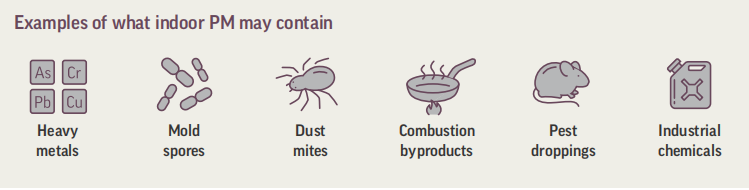
Examples of what indoor PM may contain 室内颗粒物的组成示例
- Heavy metals (重金属)
- Mold spores (霉菌孢子)
- Dust mites (尘螨)
- Combustion byproducts (燃烧副产物)
- Pest droppings (害虫排泄物)
- Industrial chemicals (工业化学品)
Smaller particles are the most concerning because they can travel deeper into the lungs than larger particles. Research has connected PM?.?, which refers to aerosol particles with a diameter of 2.5 micrometers or less, with the worst health impacts from air pollution, including heart problems, decreased lung function, and premature death in people who had a pre-existing heart or lung disease.
细颗粒物危害更大,因为它们比大颗粒更易深入肺部。研究表明,直径≤2.5 微米的PM?.?与空气污染导致的严重健康问题相关,包括心脏病、肺功能下降,以及患有心肺疾病人群的过早死亡。
Green Building Strategies 绿色建筑策略
Green buildings implement strategies to reduce exposure to PM. Once again, avoiding the introduction of pollutants (source control) is the most effective approach. But it is not possible to avoid all sources of pollution. Therefore, green buildings also rely on filtration to remove PM.
绿色建筑通过以下策略减少颗粒物暴露:最有效的方式仍是源头控制,避免引入污染物;但由于无法完全杜绝污染源,因此需依赖空气过滤去除颗粒物。
Air filters are rated based on their effectiveness at removing particles of different sizes. In North America, minimum efficiency reporting value (MERV) ratings grade filters from 1 to 16 (with higher being better) at how effective they are at capturing particles of all sizes. High-efficiency particulate air (HEPA) filters are even more effective than MERV 16 filters but are used in portable air cleaners rather than central HVAC systems.
空气过滤器的过滤效率通过 ** 最低效率报告值(MERV)** 分级,北美标准为 1-16 级(数值越高效率越高),反映其捕捉不同大小颗粒物的能力。高效微粒空气过滤器(HEPA)效率高于 MERV 16 过滤器,但通常用于便携式空气净化器,而非中央暖通空调系统。


 京公网安备 11010602007285号