Optimizing Air Quality and Energy Use 优化空气质量与能源利用
The systems that provide the mechanical ventilation and filtration required to provide healthy IAQ are often complex. These systems require a custom design optimized for occupant well-being, energy performance, maintainability, and ongoing expenses. This can require balancing IAQ and energy performance.
为保障健康室内空气质量(IAQ),机械通风与过滤系统的设计往往较为复杂,需兼顾使用者健康、能源效率、可维护性与运营成本,实现 IAQ 与能耗的平衡。
Green Building Strategies 绿色建筑策略
Green buildings implement strategies that optimize both air quality and energy usage by using a systems-based, integrated approach to identify solutions. Strategies include:
- Recirculating air if its quality is still acceptable, since pulling in outdoor air uses fan energy and requires conditioning of the air. Therefore, commercial HVAC systems use a combination of outside air and recirculated indoor air, both of which are filtered.
- Using an energy-recovery system, which conditions the incoming air with the outgoing air, as discussed in Chapter 8: Energy and Atmosphere.
- Setting different ventilation levels based on the project's typical occupancy schedule, so that the system exchanges air only as often as necessary for occupants' health, safety, and well-being.
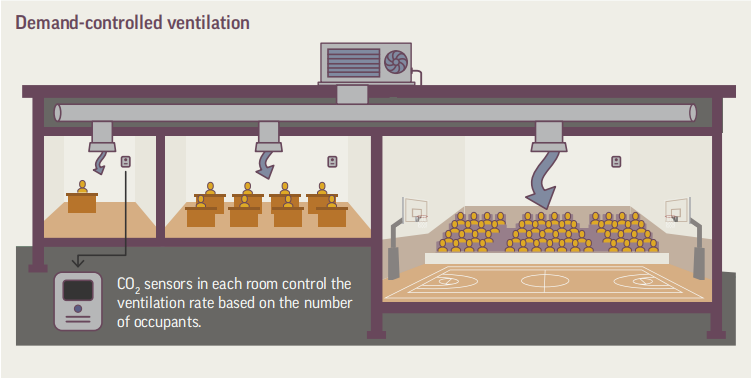
- Using demand-controlled ventilation, which automatically adjusts the airflow rate based on signals from air pollutant sensors or occupancy sensors. Most demand-controlled systems use indoor CO2 levels to trigger a higher or lower ventilation rate based on the number of occupants.
绿色建筑采用系统性集成方法,同时优化空气质量与能源利用,策略包括:
- 当室内空气质量仍达标时,循环利用室内空气(引入室外空气会消耗风机能耗并需进行温湿度调节),因此商业暖通空调系统通常采用室外新风 + 室内循环风的组合,且两者均需经过过滤。
- 采用能量回收系统,利用排风对新风进行预处理(详见第 8 章《能源与大气》)。
- 根据建筑典型使用时间表设置不同通风量,仅在保障使用者健康、安全与福祉的必要频率下进行空气交换。
- 采用按需控制通风(DCV),通过空气污染物传感器或占用传感器信号自动调节风量,多数系统以室内 CO2浓度为依据,根据人员数量调整通风速率。
图示说明:按需控制通风系统中,每个房间的 CO2传感器会根据人员数量控制通风速率。


 京公网安备 11010602007285号