Chemicals of Concern 关注化学品
Specific types of chemicals that may pose a health risk to building occupants are volatile organic compounds (VOCs), which are chemicals found in many products that can evaporate, or off-gas, at normal indoor temperatures and pressures. There are many different types of VOCs. Exposure to certain VOCs can lead to short-term health problems, like headaches, or long-term health problems, including cancer. Other VOCs have little or no apparent impact on human health or comfort.
对建筑使用者构成健康风险的典型化学物质是挥发性有机化合物(VOCs),这类物质广泛存在于各类产品中,可在常温常压下挥发或释放气体。VOCs 种类繁多,部分 VOCs 暴露可引发短期健康问题(如头痛)或长期健康问题(如癌症),其他 VOCs 则对人体健康或舒适度几乎无明显影响。
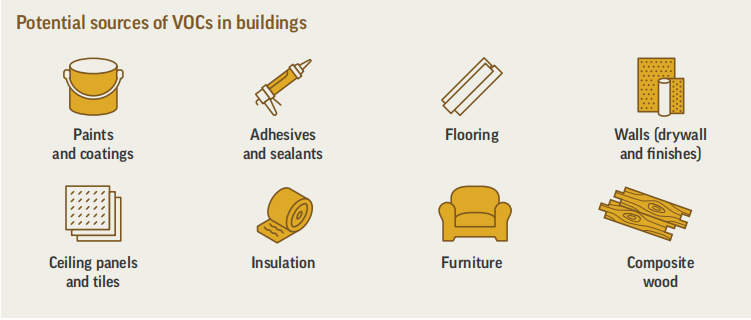
Potential sources of VOCs in buildings 建筑中 VOCs 的潜在来源
- Paints and coatings 油漆与涂料
- Adhesives and sealants 胶粘剂与密封胶
- Flooring 地板材料
- Walls (drywall and finishes) 墙面材料(石膏板与饰面)
- Ceiling panels and tiles 天花板板材与瓷砖
- Insulation 保温材料
- Furniture 家具
- Composite wood 人造板材
Additional chemicals of concern include heavy metals, which may be found in plumbing, wiring, and roofing products; PFAS (often referred to as forever chemicals, since they do not degrade in the body or in nature), which may be found in a wide range of products; plasticizers (additives used to make plastics flexible); and flame retardants (chemicals that resist ignition).
其他关注化学品还包括:重金属(存在于管道、电线与屋面产品中)、全氟和多氟烷基物质(PFAS,又称 “永久化学品”,因无法在体内或自然环境中降解而得名,广泛存在于各类产品中)、增塑剂(用于提升塑料柔韧性的添加剂)以及阻燃剂(抑制燃烧的化学物质)。
Green Building Strategies 绿色建筑策略
Green building strategies aim to reduce human exposure to VOCs and other chemicals of concern. This requires considering both the VOC content (the amount of VOCs found in the product) and the VOC emissions (the amount of VOCs that off-gas from the product during its installation and use). Strategies include:
绿色建筑策略旨在减少人体对 VOCs 及其他关注化学品的接触,需同时考虑产品 VOC 含量(产品本身的 VOC 总量)与VOC 释放量(安装与使用过程中挥发的 VOC 量),具体策略包括:
-
Selecting materials that have been tested for VOC emissions and carry a seal or label certifying that those emissions are below an established threshold. These are known as non-emitting or low-emitting products. Use of non-emitting or low-emitting products is one of the best ways to reduce the risk of exposing occupants to harmful chemicals.
选用经过 VOC 释放量测试、带有认证标识且释放量低于标准限值的材料,即 “零释放或低释放产品”。使用这类产品是降低使用者接触有害化学物质风险的有效方式之一。
-
Selecting materials with low VOC content. Use of no- or low-VOC wet-applied products (e.g., paint) during construction, renovations, or maintenance is one of the best ways to reduce the risk of exposing jobsite workers to harmful chemicals.
选用低 VOC 含量的材料。在施工、翻新或维护阶段使用零 VOC 或低 VOC 湿涂产品(如油漆),是降低施工现场工人接触有害化学物质风险的有效方式之一。


 京公网安备 11010602007285号