Refrigerants 制冷剂
Most HVAC systems rely on refrigerants, fluids that change from liquid to gas and back again as they move heat from one place to another. There are many different types of refrigerants, and the most common are powerful greenhouse gases. These gases are hundreds or thousands of times more dangerous than CO? because they can trap heat in the atmosphere much more effectively.
大多数暖通空调系统依赖制冷剂,这类工质在转移热量的过程中,会在液态与气态之间反复相变。制冷剂种类繁多,其中最常见的是强效温室气体。这些气体的温室效应是二氧化碳的数百至数千倍,能更高效地在大气中截留热量。
This is a problem because the seals in cooling and heating systems are never perfect, and they tend to leak throughout the lifetime of the equipment, releasing these powerful greenhouse gases. There is also the risk of a major leak, caused by a catastrophic event or when a system is recharged or decommissioned.
由于制冷与制热系统的密封件无法做到绝对无泄漏,设备全生命周期内都会缓慢释放这些强效温室气体;此外,极端事件、系统充注或报废阶段也可能导致大规模泄漏。
Green Building Strategies 绿色建筑策略
Green buildings manage refrigerants over the project’s life cycle by:
- Selecting systems that use refrigerants with the lowest possible global warming potential (GWP), which measures how much energy one ton of a gas will absorb over a given period of time relative to CO?. The larger the GWP, the more a given gas warms the Earth compared to CO?.
- Selecting systems that use refrigerants that do not deplete the ozone layer
- Designing systems to use no more refrigerant than necessary
- Managing HVAC systems to minimize leaks and to catch them quickly if they occur
- Developing protocols for HVAC maintenance and decommissioning to help ensure refrigerants are captured and either recycled or destroyed
绿色建筑通过以下方式在项目全生命周期内管控制冷剂:
- 选用 ** 全球变暖潜能值(GWP)** 尽可能低的制冷剂;GWP 衡量一吨气体在指定时间内吸收热量的能力,以二氧化碳为基准。GWP 越高,该气体对地球的增温效应越强。
- 选用不破坏臭氧层的制冷剂
- 优化系统设计,避免制冷剂过量充注
- 加强暖通系统运维,降低泄漏风险并实现泄漏快速响应
- 制定运维与报废阶段的规范流程,确保制冷剂被回收、再利用或无害化处理
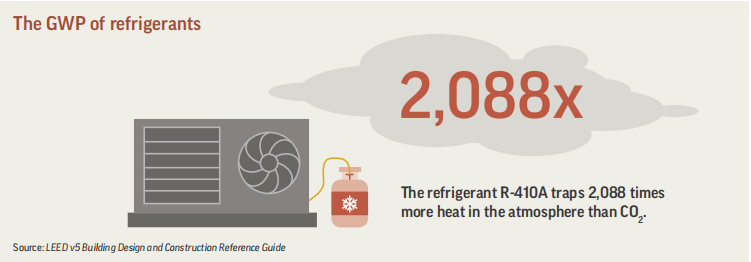
The GWP of refrigerants 制冷剂的全球变暖潜能值
The refrigerant R-410A traps 2,088 times more heat in the atmosphere than CO?.
制冷剂 R-410A 在大气中截留热量的能力是二氧化碳的 2088 倍。
来源:LEED v5 Building Design and Construction Reference Guide


 京公网安备 11010602007285号