CHAPTER 9 Materials and Resources
第 9 章 材料与资源
Buildings are made up of many materials and products – from those used to construct the structure to the interior finishes within. These materials all have a life cycle, as they are harvested from raw sources, manufactured, transported, used, and eventually reused or disposed of. At every step along this cycle, materials impact people and ecosystems.
建筑由大量材料与产品构成,从结构用材到室内饰面材料均包含在内。这些材料都有其完整生命周期:从原料开采、生产制造、运输、使用,到最终被回收再利用或废弃处理。在生命周期的每个阶段,材料都会对人类与生态系统产生影响。
Why it matters: 重要性说明
-
Some ingredients in building materials are known to be hazardous. Depending on how they are used, these hazardous materials can increase health risks to jobsite workers and/or building occupants.
建筑材料中的部分成分具有危害性,其使用方式可能会增加施工现场工人和 / 或建筑使用者的健康风险。
-
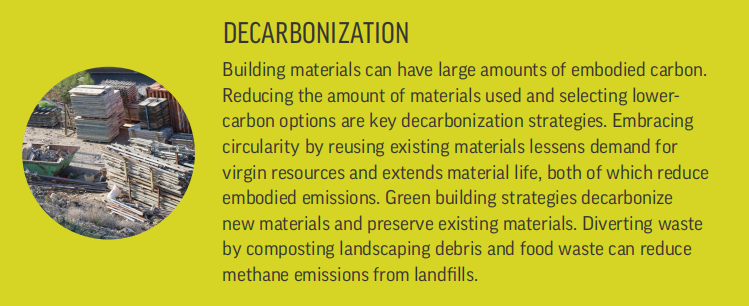
The materials used to construct a building and the products used within it require resources to extract, manufacture, use, and dispose of. Therefore, building materials have embodied impacts, including embodied carbon emissions.
建筑用材及内部产品的开采、生产、使用与处置过程均需消耗资源,因此建筑材料存在隐含环境影响,其中包括隐含碳排放。
-
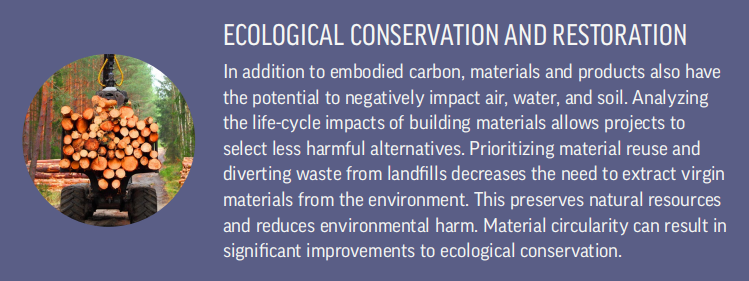
Both the construction and operation of buildings generate waste that, unless diverted, will end up in landfills or incinerators. The presence of any hazardous materials in this waste further complicates its disposal.
建筑施工与运营阶段都会产生废弃物,若不进行分流处理,最终将进入垃圾填埋场或焚烧厂;若废弃物中含有有害物质,将进一步提升处置难度。
How Materials and Resources strategies can help: 材料与资源策略的作用
-
Reducing the amount of material used in the construction and operation of buildings lowers the embodied carbon emissions and other types of pollution associated with building materials.
减少建筑施工与运营阶段的材料用量,可降低建筑材料相关的隐含碳排放及其他污染。
-
Reusing and recycling materials reduces dependence on virgin resources and minimizes waste.
材料的再利用与回收可降低对原生资源的依赖,同时减少废弃物产生。
-
Evaluating materials and products based on their holistic impacts enables thoughtful material selection that aligns with project goals and priorities.
基于全生命周期影响对材料与产品进行评估,可帮助项目做出契合目标与优先级的合理选材决策。
MATERIALS AND RESOURCES TERMS 材料与资源术语
CHEMICALS OF CONCERN 关注化学品
- Volatile organic compounds (VOCs): Chemicals found in many products that can evaporate, or off-gas, at normal indoor temperatures and pressures.
挥发性有机化合物(VOCs):广泛存在于各类产品中,可在常温常压下挥发或释放气体的化学物质。
MATERIAL SUFFICIENCY 材料充足性
- Material efficiency: Using less material to perform the same function or produce the same results. This is also referred to as material-use optimization.
材料效率:以更少的材料实现同等功能或产出的方式,也称为材料利用优化。
- Sufficiency: A set of measures and practices that avoid demand for energy, materials, land, and water while delivering human well-being within planetary boundaries.
充足性:在地球承载范围内,保障人类福祉的同时,减少对能源、材料、土地和水资源需求的一系列措施与实践。
MATERIAL CIRCULARITY 材料循环性
- Material circularity: An approach where resources are continuously reused and recycled, reducing dependence on virgin resources and minimizing waste.
材料循环性:通过资源的持续再利用与回收,降低对原生资源的依赖并减少废弃物产生的模式。
LIFE-CYCLE ASSESSMENT 生命周期评估
- Life-cycle assessment (LCA): An evaluation of the environmental impact of a building product or a whole building project over its entire life cycle, from raw material extraction to construction and disposal. An LCA provides valuable information for decision-making related to design, construction, operation, maintenance, and eventual reuse, recycling, or disposal.
生命周期评估(LCA):对建筑产品或项目从原材料开采、施工到处置的全生命周期环境影响进行评估的方法,可为设计、施工、运营、维护及最终再利用、回收或处置的决策提供依据。
HOLISTIC MATERIAL ASSESSMENT 材料综合评估
- Multi-attribute certifications: Certifications that rate products on their performance across multiple measures, such as environmental and social impact.
多属性认证:从环境、社会影响等多个维度对产品性能进行评级的认证体系。
CONSTRUCTION WASTE 施工废弃物
- Overage: The extra material ordered for building construction just in case it’s needed.
余量材料:为应对施工中的意外情况,额外订购的建筑材料。
OPERATIONS WASTE 运营废弃物
- Waste diversion: Diverting waste from landfill and incineration facilities.
废弃物分流:通过回收、再利用等方式,避免废弃物进入填埋场或焚烧设施。
LEED Impact Areas: Materials and Resources
The Materials and Resources strategies in LEED address all three of LEED’s impact areas:


 京公网安备 11010602007285号